At a trade show in January, a robot glides across polished concrete and lifts a tray of seedlings with perfect precision. Six weeks later, in a field that has been wet since November, the same class of machine is nowhere to be seen. That gap between the demo hall and the gateway is where most of the real story about how technology is changing agriculture actually lives. Some of it is genuinely transformative. Some of it is a solution looking for a problem. This is a grounded look at what is shifting on working farms, what it costs, and where the marketing has run ahead of the mud.
Sensors and Data: The Quiet Revolution
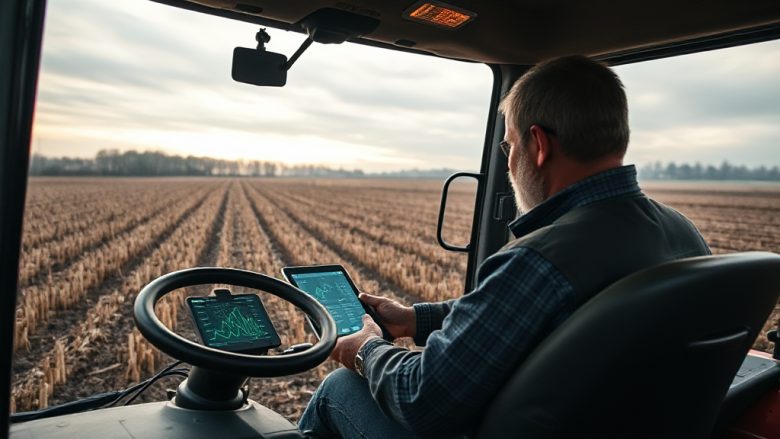
The least glamorous technology is often the one that sticks. Soil moisture probes buried at 30cm and 60cm, weather stations on the yard, and yield monitors bolted to the combine have been quietly accumulating data for years. The change now is that this data is cheaper to collect and easier to act on.
A basic soil moisture sensor used to be a research instrument. Now a farmer can put half a dozen across a field for the price of a decent set of winter tyres and check them from a phone at breakfast. That matters most in a dry spring, when the difference between irrigating on Tuesday and irrigating on Friday can be several tonnes of yield. It also matters in a wet autumn, when knowing which headland is still saturated can save a tractor from a very expensive rescue.
Variable rate application is the practical payoff. Instead of spreading the same bag of fertiliser across every acre, a prescription map tells the spreader to back off on the thin gravelly patch and push a bit harder on the heavy clay. On mixed farms with variable ground, this is not a gimmick. It is a way to stop wasting inputs on land that will never respond. The catch is that variable rate only works if you have good mapping, and good mapping takes time to build. Farmers who have been collecting yield data for a decade are in a much stronger position than those starting from scratch.
Where the hype outruns reality is in the dashboard. Every platform promises a single screen that tells you everything. In practice, most farms end up with three or four systems that do not talk to each other, and somebody spends Sunday evening copying numbers between them. Data ownership and interoperability remain the boring, unresolved problems that nobody puts on a conference banner.
Automation and Machinery: Where the Promise Meets the Mud
Autosteer is the success story nobody argues about. GPS-guided steering has been standard on new tractors for years, and it has quietly done more for operator fatigue and overlap reduction than almost anything else. A driver who used to spend a long day wrestling a plough down a hillside now supervises. That is a real change, and it happened without much fuss.
Beyond autosteer, the picture gets messier. Autonomous tractors and robotic weeders work well in orchards, vineyards, and high-value vegetable beds where the rows are regular and the crop is worth a lot per hectare. They struggle in a 20-hectare field of wheat where the margins are thin and the ground is uneven. The economics simply do not stack up yet for broadacre combinable crops, and anyone who tells you otherwise is probably selling something.
Drones have found a genuine niche in scouting and spraying on steep or awkward ground, but the regulatory picture varies enormously by country and the battery life is still a limiting factor on bigger jobs. Spot spraying, where a camera identifies a weed and only that weed gets a dose, is one of the more promising developments because it attacks a real cost. Herbicide resistance is a genuine problem on many farms, and reducing overall chemical use while keeping the crop clean is exactly the kind of thing that pays for itself.
The honest summary is that automation is arriving unevenly. It is already here on high-value, high-labour crops. It is coming, slowly, to the rest. The limiting factor is rarely the technology itself. It is the capital cost, the repair bill, and the fact that a machine that breaks down at harvest is worse than no machine at all.
Livestock Monitoring: Small Devices, Real Benefits
Livestock tech has been one of the more convincing areas, partly because the problems it solves are so concrete. A cow that is lame, calving, or off her feed is a cost. Finding her early is worth money. Accelerometer ear tags and boluses can flag changes in activity and rumination before a stockman would notice by eye, and on a large dairy herd that early warning is genuinely useful.
Virtual fencing, where collars give an audio cue and then a mild pulse to keep cattle within a boundary, is moving from trial to commercial use in several countries. It allows grazing to be rotated without miles of temporary electric fence, which saves labour and can improve pasture management. It is not for every system, and welfare questions deserve honest answers, but it is one of the few technologies that changes how a farm operates day to day rather than just adding a dashboard.
Milk yield sensors, automatic drafting, and heat detection have been standard on larger dairy units for a while. On smaller beef and sheep farms, the adoption is slower because the per-animal cost is harder to justify. A tag that costs more than the margin on a store lamb is not a sensible purchase, however clever it is.
Connectivity and Cost: The Barriers Nobody Advertises
None of this works without a signal. Rural broadband and mobile coverage remain the single biggest practical obstacle to farm technology in many areas. A sensor that cannot upload its data is just a piece of plastic in a field. Farmers in valleys, on moorland, and in older buildings know this better than anyone.
Then there is cost. The headline price of a new precision drill or a herd monitoring system is only part of the story. There is the subscription, the annual software licence, the replacement tags, the training, and the fact that a machine bought today may be obsolete in seven years. For a farm with a modest turnover, that is a serious commitment. Grant schemes help, but they come and go with political cycles, and nobody wants to build a business around a subsidy that might vanish.
There is also a skills question. Many farmers are perfectly capable of running complex machinery, but the time to learn a new platform is time not spent on stock or crop. The best tools are the ones that fit into the existing day rather than demanding a new one.
What Is Actually Changing on Ordinary Farms
Strip away the conference slides and a few things stand out as genuinely embedded. Autosteer, yield mapping, variable rate fertiliser, and livestock activity monitoring are all in real use on real farms, and they are making a difference to input costs and labour. They are not exciting, which is probably why they work.
Robotics and AI are further along in horticulture and dairy than in combinable crops, and that is likely to remain true for a while. The farms getting the most out of technology tend to be the ones that started with a specific problem, not the ones that bought a platform and then looked for something to do with it. That is the opposite of how the marketing usually works.
Outlook: Slower, Patchier, and More Useful Than the Hype Suggests
The next few years will probably bring better interoperability, cheaper sensors, and more capable spot spraying. Electric and hybrid drivetrains will creep into smaller machines. Satellite connectivity may finally solve some of the coverage problem in remote areas, though the cost will decide how quickly.
What will not change is the fundamental test. A technology earns its place on a farm when it saves more than it costs, when it works in bad weather, and when it does not demand a technician on standby at harvest. The trade-show robot will keep improving. The muddy field in February will keep asking harder questions. The farms that thrive will be the ones that ignore the noise and adopt the tools that pass the test.